The Visit of the Wise Men: Lessons from Matthew 2:1-12
- Lester Potts
- 6 days ago
- 4 min read
The account of the wise men visiting Jesus, found in Matthew 2:1-12, is a familiar part of the Christmas story, but its true biblical context is often misunderstood or overlooked. This passage offers a rich narrative that not only highlights the sovereignty of God in revealing His Son to the world but also brings to light important truths for all believers.
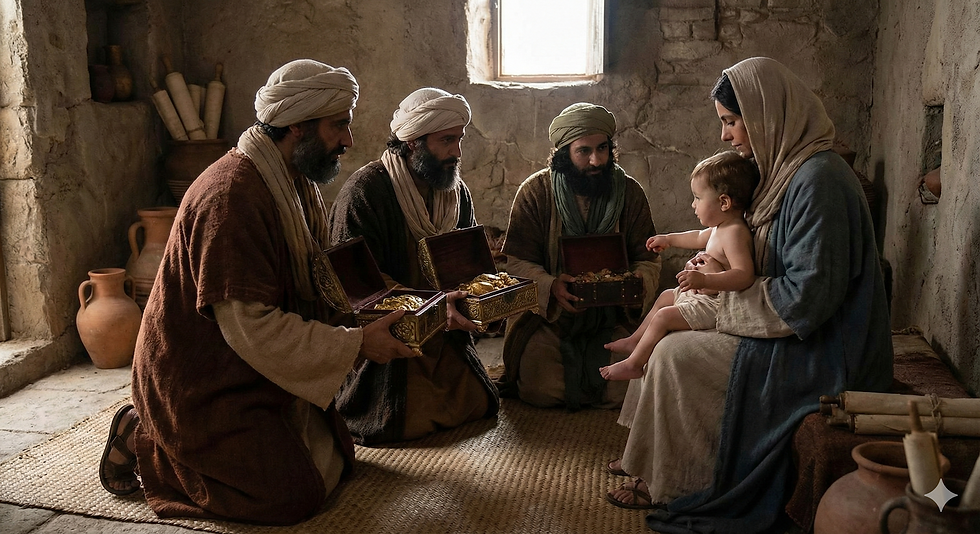
After Jesus was born in Bethlehem during the reign of King Herod, a group of wise men from the East arrived in Jerusalem. These men, often referred to as Magi, came seeking the one "who has been born King of the Jews," explaining that they had seen His star in the East and had embarked on their journey to worship Him. Their arrival and inquiry unsettled Herod, as well as the people of Jerusalem. In response, Herod assembled the chief priests and scribes to determine where the Christ was to be born. The religious leaders confirmed, citing the prophecy in Micah 5:2, that the Messiah would be born in Bethlehem of Judea.
Secretly, Herod summoned the wise men, questioning them about the timing of the star's appearance. He then sent them to Bethlehem with the instruction to search diligently for the child and to report back, feigning his own desire to worship. Guided by the same star they had seen in the East, the Magi traveled to Bethlehem, rejoicing greatly when the star stopped over the place where Jesus was. Upon entering the house, they saw the young Child with His mother, Mary, and fell down in worship—not of Mary, but of Christ Himself. They offered gifts of gold, frankincense, and myrrh. Afterward, according to Matthew 2:12, the Magi were divinely warned in a dream not to return to Herod, so they left for their own country by a different route.
Before delving deeper into the theological and practical implications of this passage, it is important to clarify several common misconceptions regarding the wise men. First, Scripture never states how many wise men there were. The tradition of "three kings" likely arose from the mention of three gifts, but the Bible does not specify their number. Second, the Magi did not visit Jesus at the manger soon after His birth. Instead, their journey began after Christ was already born, and by the time they arrived, the family was living in a house. In fact, based on Herod's later order to kill all boys two years old and under (Matthew 2:16), Jesus may have been as old as two when the Magi arrived. Third, while tradition often asserts that the Magi came from Persia, the Scriptures only say that they traveled from the East, which could have been from regions corresponding to modern-day Iraq or Iran.
Why is this event significant enough for Matthew to include it in his Gospel? The Magi were not kings, but rather astrologers or scholars, likely Gentiles, who studied the stars in search of meaning. That God would call such men—Gentiles and outsiders—to recognize and worship the newborn King demonstrates His sovereign will and hints at the broader inclusion of Gentiles in the kingdom of God. Their journey is frequently interpreted as a prophetic sign pointing to the future worship of Jesus by all nations, not just Israel. This foreshadowing finds its fulfillment in passages like Philippians 2:9-11, which declares that God has highly exalted Jesus and that one day every knee will bow and every tongue confess that He is Lord.
The experience of the Magi offers valuable lessons for those seeking to find and follow God's will. First, they followed the light God gave them—symbolized by the guiding star. This resonates with passages such as John 1:4-5, where Christ is described as the light of humanity, shining in the darkness. Second, the Magi confirmed their actions through scripture, consulting the Jewish prophecies concerning the Messiah’s birth. And third, they obeyed God without hesitation, even when it meant disobeying Herod’s orders and returning home another way. These steps—following God’s guidance, confirming it through His Word, and obeying without reservation—serve as a blueprint for how believers should respond to God’s direction in their own lives. As Psalm 119:105 affirms, "Your word is a lamp to my feet and a light to my path." God provides precepts and laws for His people to walk in obedience, as Nehemiah 9:14 testifies.
Matthew emphasizes that the Magi worshiped Jesus, not Mary. If ever there were an opportunity to honor her, it would have been in that sacred moment. Yet, the wise men, guided by truth, recognized only Jesus as worthy of worship. The gifts they presented—gold, frankincense, and myrrh—carry great symbolic significance. Gold speaks to His kingship and majesty; frankincense, often used in worship, signifies the fragrance and purity of His life; and myrrh, associated with burial, foreshadows His suffering and death.
Finally, the warning in a dream that led the Magi away from Herod is a reminder to be cautious of the traps and deceptions present in the world. Above all, the greatest gift God gave humanity was Himself—through the incarnation, obedient life, sacrificial death, and victorious resurrection of Jesus Christ. Entrance into God’s eternal kingdom is available to all, but it requires recognizing our need for a Savior, believing in Christ’s atoning work, and embracing the promise recorded in John 3:16: "For God so loved the world that He gave His only begotten Son, that whoever believes in Him should not perish but have everlasting life."
Thus, the story of the wise men goes far beyond the nativity scene. It is a powerful demonstration of God’s call to all nations, a model for seeking and obeying divine guidance, and a testament to the incomparable worth of Jesus Christ, to whom all honor and worship rightfully belong.


Comments